

Bad posture problem isn’t just about how you look—it’s about how your entire body functions. What begins as a subtle habit, like leaning your head forward or rounding your shoulders, can quietly evolve into a network of aches, stiffness, and chronic discomfort. ss rarely stay local. They spread.
Your body works as one connected system. Bones stack, muscles coordinate, nerves glide, and joints share load. When one link in that chain shifts out of place, everything else adapts. That adaptation is what eventually becomes pain.
This is why people searching for postural alignment therapy or posture alignment therapy often feel pain in areas far from the original problem. A forward head posture may show up as shoulder tension. A tilted pelvis may become knee or foot pain. Understanding this “chain reaction” is the first step toward lasting relief.
Let’s explore six common posture problems and how each one can turn into full-body pain.
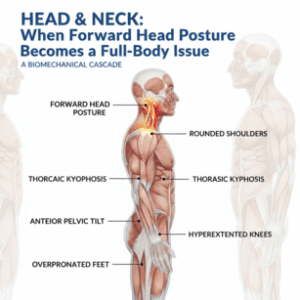
1. Head & Neck: When Forward Head Posture Becomes a Full-Body Issue
Head forward posture is one of the most common results of modern life. Screens pull the head forward, and every inch the head drifts ahead of the shoulders adds significant load to the neck.
People often search for how to fix forward head posture or forward head posture fix because they feel:
- Neck and upper-back tightness
- Tension headaches
- Jaw discomfort
- Tingling into the arms
But the effects don’t stop there. A forward head shifts the upper spine, changes breathing mechanics, and forces the shoulders to round. The nervous system becomes compressed, and the body compensates down the chain.
Many people try quick fixes like braces or even look into forward head posture chiropractic care without addressing daily habits. Real change comes from restoring alignment through movement, awareness, and sleep posture—learning how to correct forward head posture while sleeping and during daily activities.
When the head returns to neutral, the spine can stack correctly, breathing improves, and strain in the shoulders and mid-back eases.
2. Shoulders: Pain in the upper body and rounded shoulders
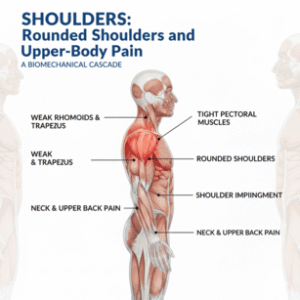
A forward head and rounded shoulders commonly go together. The chest gets tighter, the upper back gets weaker, and the arms move forward over time.
People who have pain in their shoulders and bad posture typically say:
- Burning in the area between the shoulder blades
- Limited mobility of the head
- Numbness in the arm
- Tightness in the upper chest
Searches for “rounded shoulders fix,” “rounded shoulders vs. normal,” and “rounding of shoulders” show how frequent this problem is.
Bad shoulder posture doesn’t simply affect the arms; it also changes how the ribs move and how you breathe. This is why a lot of people have bad posture and chest discomfort, bad posture and rib pain, or bad posture and rib pain. When the rib cage can’t expand properly, every breath gets shorter and the tissues around it get inflamed.
Learning how to sleep to repair rounded shoulders and get your upper back moving again will help with nerve irritation, breathing, and pain in your chest and ribs.
3. Spine: When One Curve Changes Everything
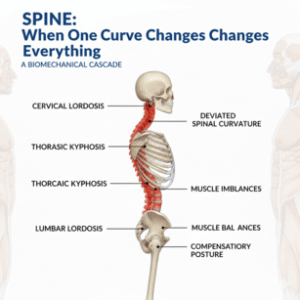
The spine is designed with natural curves. These curves distribute load and absorb shock. When posture problems flatten or exaggerate those curves, the body must compensate.
A stiff thoracic spine can overload the neck and lower back. A collapsed lower back can stress the hips. Over time, this imbalance becomes chronic posture and pain.
People often treat back pain in isolation, but the real cause is frequently above or below the painful area. This is why postural alignment therapy focuses on restoring global movement, not just local relief.
A spine that moves well allows the body to transfer force efficiently. When one segment stops moving, another segment works overtime—and that overwork becomes pain.
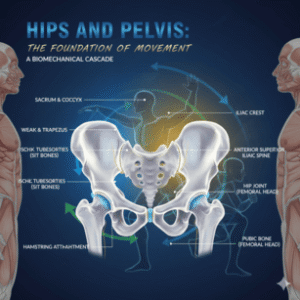
4. Hips & Pelvis: The Foundation of Movement
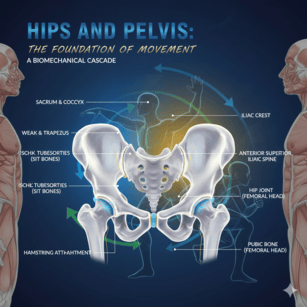
The pelvis is the base of the spine and the bridge between upper and lower body. Small shifts here can change everything.
Common complaints include:
- Pain in pelvis and hip
- Hip and pelvis pain
- Nerve symptoms from compression of the nerves in hip and pelvis
- Pelvis and hip pain during pregnancy
An anterior or posterior pelvic tilt alters how the core and glutes function. When these muscles fail to support the body, the lower back tightens, the hips lose stability, and the knees begin to absorb forces they weren’t designed to handle.
Pelvic misalignment doesn’t just cause local discomfort—it sets the stage for knee and foot pain. This is why people with hip issues often develop pain further down the chain.
5. Knees: The Middle That Pays the Price
Knees are often blamed, but they’re rarely the original problem.
Searches like:
- Pain behind knee
- Inner knee pain
- Pain on outside of knee
are common among people whose hips or feet aren’t aligned.
When hips rotate inward or outward due to pelvic imbalance, the knees are forced to track incorrectly. Over time, cartilage wears unevenly, ligaments strain, and inflammation sets in.
The knee becomes a victim of upstream and downstream posture problems. Fixing the knee alone rarely works. Restoring hip stability and foot alignment reduces stress and allows the joint to move naturally again.

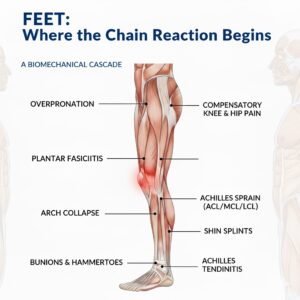
6. Feet: Where the Chain Reaction Begins
Your feet are the foundation of posture. Every step sends information upward through the body.
Collapsed arches, uneven weight distribution, and stiff ankles contribute to:
- Local discomfort
- Altered walking patterns
- Compensations in knees, hips, and spine
This is why people searching for relieve feet pain often also experience back to feet pain. The body adapts from the ground up.
When the feet fail to absorb shock, that force travels upward. Knees stiffen. Hips tighten. The spine braces. Eventually, even the neck and shoulders feel the effects.
Restoring foot strength and mobility can dramatically improve posture throughout the entire body.
Conclusion: Don’t just treat the pain; treat the pattern.
Postural issues are seldom singular. A tiny inaccuracy in one place sets off a chain reaction of adjustments throughout the body. Pain is the last indicator, not the cause.
Each problem, whether it’s forward head posture, rounded shoulders, pelvic instability, or collapsing arches, impacts the whole chain. This is why postural alignment therapy works best when it looks at the full system.
Bracing, forcing, or pursuing symptoms won’t give you long-term relief. It comes from getting the body back into its natural alignment, making it easier to move, and teaching it how to sustain itself again.
Pain goes away as posture gets better, not because it’s hidden, but because the body doesn’t need to make up for it anymore.
want to read more articles? Click here


Pingback: Acute Versus Chronic Pain Explained: Symptoms, Diagnosis, and Treatment - alignedliving.blog
Pingback: 7 Key Differences Between Anterior and Posterior Pelvic Tilt (and How to Fix Them) - alignedliving.blog